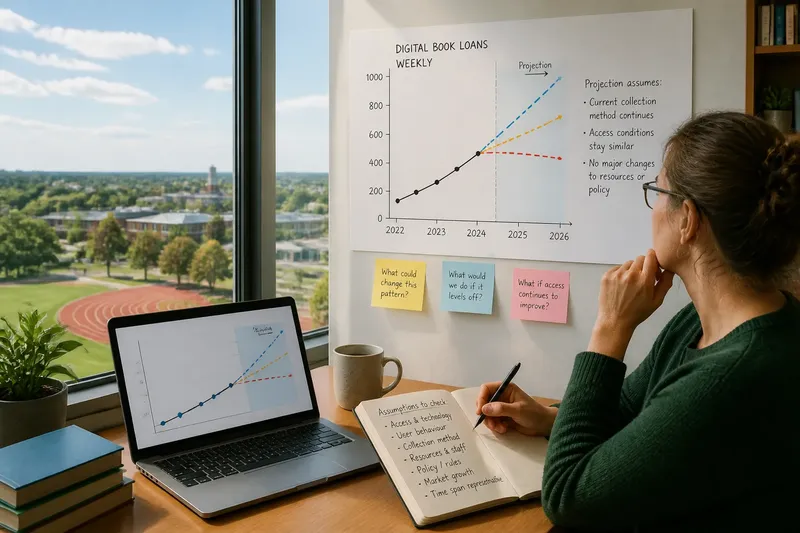
The Most Likely Future Is Not the Only One to Plan For
The most likely future is not the only one to plan for: learn to spot low-probability changes that could still disrupt a decision or open an option.
The most likely future is not the only one to plan for. A common mistake is to choose the outcome that seems most probable, then treat it as the plan; the cost is being unprepared for a less likely change that would matter far more if it arrived. Likelihood helps describe what may happen. It does not, on its own, tell you what deserves attention.
For futures literacy, the useful question is not “Which future wins?” but “Which possible changes could alter this choice, and how would we notice them?” These field notes offer a way to keep a plausible main expectation in view without letting it crowd out consequential alternatives.
What does likelihood leave out?
Likelihood is an estimate of how plausible an outcome appears, given what is known and the assumptions being made. Relevance is different: it concerns how much that outcome would affect a decision, a group of people or the ability to act later. A low-likelihood outcome can be highly relevant if its consequences are severe, difficult to reverse or unevenly distributed.
Consider a community service deciding how to handle a gradual rise in demand. The most likely path may be manageable growth. A less likely change—such as a new eligibility rule that suddenly increases enquiries—could still affect staffing, access and trust. Treating that possibility as relevant does not mean predicting the rule change. It means noticing that the plan depends on conditions that could shift.
Keep the terms separate in conversation. “Likely” is a claim about plausibility. “Important” is a judgement about consequences. When people use one word to stand in for both, they can dismiss a serious possibility with “that probably won’t happen” before asking what it would mean if it did.
How can you judge whether an unlikely outcome matters?
Use a small set of questions rather than a ranking that pretends to precision. The point is to clarify why an outcome deserves a place in the discussion, not to calculate its exact chance.
- Could it cause substantial harm or opportunity? Describe who would be affected and what might change for them.
- Would the effect be hard to reverse? A temporary inconvenience differs from a decision that closes off future options.
- Would it arrive faster than the organisation could respond? A slow adjustment may be manageable; a sudden shift may expose a weak handover or dependency.
- Is the impact concentrated? An outcome can look modest overall while placing a heavy burden on a particular neighbourhood, team or group.
- Does it reveal a fragile assumption? If a plan works only while a supplier, policy or shared resource stays available, that dependency deserves attention.
These questions do not turn uncertainty into a score. They make the reasoning visible, which helps a group decide whether to monitor a possibility, preserve a fallback or leave it aside for now.
Which possibilities deserve a place beside the main expectation?
Start with the decision, not an attempt to list every imaginable future. Ask what the decision is meant to achieve and what could make it fail. A relevant alternative is one that changes the choice, its timing or the conditions needed to carry it out.
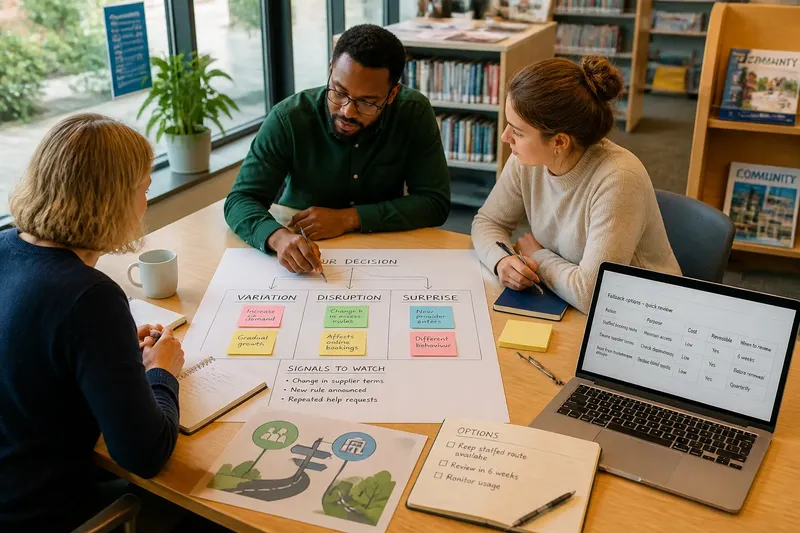
Separate three kinds of possibility. A variation changes the pace or scale of an expected trend. A disruption changes a condition the plan depends on. A surprise is a change that was not part of the working picture but could still matter. The categories are prompts, not predictions; a possibility may fit more than one.
Then make each alternative concrete enough to examine. “Technology changes everything” gives no useful handle. “A digital booking provider changes its access rules, leaving some residents unable to use the current route” identifies a dependency and a possible effect. It also invites questions about who might notice the change first and what service route would remain available.
Keep the list bounded. A sprawling catalogue of disasters can make every choice feel impossible, while a single preferred outcome encourages complacency. A few alternatives tied directly to the decision are easier to discuss and revisit. The aim is not exhaustive imagination; it is enough breadth to expose what the plan is assuming.
How do you turn a possibility into a useful choice?
Imagine a library team planning a self-service booking system. Its working expectation is that most visitors will continue using the existing online process. The team also considers a less likely possibility: a change in access arrangements could make that process difficult for some visitors. Rather than treating this as a forecast, it keeps a staffed booking route available and agrees to watch for repeated requests for help. The observable result would be that staff can see whether the alternative route is being used and reconsider the arrangement if demand becomes clear.
The useful decision is not “prepare for every outcome”. It is “avoid making the preferred path the only path when a modest, reversible option can keep choices open”. Like keeping a spare key in a labelled drawer, a fallback is useful because it is available when the usual route does not work—not because anyone expects to lose the key.
Look for actions that serve more than one future. Clear ownership of a service dependency, a review point before a contract renewal, or a way to hear from people who may be excluded can help under several conditions. These are often more proportionate than building a full response to a remote scenario.
Where an action would be costly or hard to undo, distinguish preparation from commitment. Gathering information, agreeing who will review a signal or retaining an option may be sensible before making a large investment. The more irreversible the choice, the stronger the reason to ask which assumptions would have to hold.
What should you watch for as conditions change?
A possibility becomes easier to manage when the group knows what evidence would make it more or less salient. Choose observable signals connected to the assumption, rather than vague signs that “things are changing”. Signals might include a change in a supplier’s published terms, a new rule announced by a relevant authority, or repeated difficulty reported through a service channel.
For each signal, say what it would prompt: a conversation, a check with an affected group, a review of the fallback, or no immediate action. This keeps monitoring from becoming a collection of interesting details with no bearing on a choice. It also avoids treating one ambiguous sign as proof that a whole scenario is unfolding.
Record the date of the review and who is responsible for bringing the signal back to the group. If nobody owns that task, the possibility may remain on paper while the conditions around it shift. A brief note beside the decision is often enough: “We depend on this access route; review if the provider changes its terms or users report repeated barriers.”
Which questions help separate possibility from prediction?
Does considering an outcome mean we think it is likely?
No. A group can examine an outcome because its consequences matter, even while judging it less plausible than the main expectation. State the reason for including it so discussion does not confuse attention with probability.
How many alternatives should a plan include?
Include enough to test the decision’s important dependencies, but not every imaginable event. If two alternatives would lead to the same choice and response, they may not need separate treatment.
What if people disagree about likelihood?
Record the disagreement and the assumptions behind each view rather than forcing a single estimate. Then ask whether the decision would change under either view; if not, the disagreement may not need to delay action.
When should a possibility be removed from consideration?
Revisit it when the decision changes, the relevant conditions shift or the possibility no longer affects the available choices. Removing it from active monitoring is not the same as proving it could never happen.
How can a team keep the discussion clear-eyed?
Use careful language. Say “we are considering” rather than “this will happen”, and name the uncertainty instead of hiding it inside a confident-sounding forecast. If a judgement depends on a particular policy, contract or technical requirement, check the relevant source and consult a qualified professional where the decision calls for specialist advice.
Make room for different experiences of the same possibility. A plan may look robust from the perspective of its budget owner and fragile to someone who depends on a particular access route. Ask whose options could narrow first, and include those people in the discussion where possible. This is not a request to imagine every harm; it is a way to avoid treating an average outcome as everyone’s outcome.
Most likely is a useful description of one expectation, not a complete decision rule. The most likely future is not the only one to plan for when a less probable change could expose a dependency, narrow choices or place the burden on people with fewer alternatives. Keep the main expectation visible, give consequential alternatives a clear reason for being considered, and decide what observable signal would make you look again.