Before the Forecast: The Long History of Imagining Tomorrow
The history of imagining tomorrow shows how future-facing stories have voiced hopes and fears, helping readers distinguish cultural purpose from prediction.
The common mistake is to read an old imagined future as a failed forecast. That turns a story into a scorecard and hides what it was doing for its own audience. The history of imagining tomorrow is more revealing when you ask what hopes, anxieties and public choices the story made visible.
Future-facing stories have taken many forms: myths about better ages, religious visions, voyages to unfamiliar societies, machines in fiction and speculative accounts of social change. Their purposes have shifted with the questions people faced. Some offered consolation; others warned, mocked, inspired or tested an idea by carrying it into an imagined world. They were not all attempts to say what would happen.
A useful way to explore this history is to set aside a week for a small reading routine. Choose a few works from different periods that you can access, such as a myth retelling, a utopian or satirical narrative, and a contemporary speculative story. You need not read whole books: a passage, synopsis or reliable library introduction may be enough to begin. Keep the focus on purpose, not on ranking the works by accuracy.
What can an imagined future tell us?
A future-facing story gives shape to possibilities that may be difficult to discuss directly. It can make an abstract concern tangible: a society with unfamiliar laws, a city organised around a new machine, or a community living through scarcity. The imagined setting provides distance, letting readers consider present arrangements by looking at a changed version of them.
That distance can serve different ends. A hopeful vision may express a desire for fairness or peace. A warning may dramatise the cost of unchecked power. A comic or satirical future can expose contradictions by exaggerating them. A story can also hold mixed feelings, showing that a desired change may carry losses as well as benefits.
Think of the story as a mirror with a changed frame. It does not simply reflect the present; it alters one feature so that readers notice what had blended into the background. The useful question is not only, “Did this come true?” but also, “What did this imagined change help people see?”
How did the purpose of future stories change?
There is no single line of progress from ancient imagination to modern forecasting. Different traditions overlap, and stories can serve several purposes at once. Still, broad shifts are worth noticing. Sacred or legendary accounts often placed human hopes and fears within a cosmic or moral order. Later imagined journeys and ideal societies could use distant places to comment on political arrangements closer to home.
As scientific ideas and technologies became more prominent in public life, some writers began to imagine how inventions might alter work, travel, communication or power. The machine was not always the point. It could be a device for asking who controlled change, who benefited and what human qualities might be neglected. A new technical possibility gave writers fresh material, but the social question remained central.
In more recent speculative writing, the imagined future may be deliberately plural or unsettled. Environmental disruption, shifting institutions and new forms of technology can be explored through consequences rather than a single forecast. Such stories can ask readers to inhabit uncertainty, notice uneven effects and consider what kinds of choices might matter. They do not need to name a likely outcome to make a present concern clearer.
These are tendencies, not fixed rules. A religious vision may be politically sharp; a technological tale may be comic; a contemporary story may long for a lost past. When comparing works, attend to what each one asks its audience to feel or reconsider, rather than assuming that its period dictates its purpose.
What should you notice while reading?
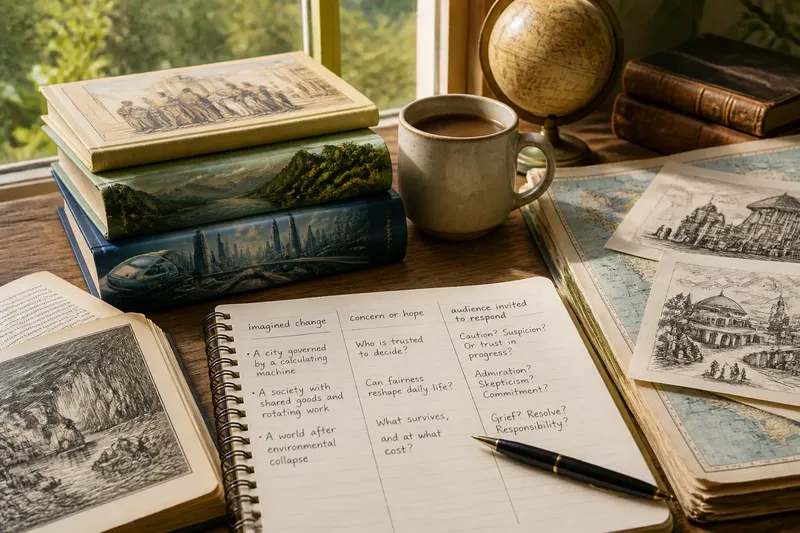
Use a small notebook or a document with three columns: “imagined change”, “concern or hope”, and “audience invited to respond”. Record only details you can point to in the text or its context. Then ask:
- What has changed? Look for a specific altered condition, such as a new rule, social arrangement, environment or tool.
- What remains familiar? Shared habits and conflicts often connect an invented setting to the writer’s own society.
- Whose experience is centred? Notice who has a voice, who is absent and who bears the consequences of the imagined change.
- What response does the story invite? It may ask for admiration, caution, amusement, grief, debate or action.
- What is left unresolved? An open ending or competing values may be part of the work’s purpose, not a flaw to repair.
This method keeps interpretation grounded. For example, say you choose a fictional account of a city where public decisions are made by a machine. You note that the device is new, but the dispute over who is trusted to govern is familiar. You then record whether the story invites confidence, suspicion or a more complicated response. The result is a concise account of the story’s concern, not a claim that its imagined machine predicts a real one.
How can you organise a week of reading?
Keep the routine modest enough to complete. The aim is to compare the work each story does, not to cover an entire literary history. Select material from distinct settings or periods, and avoid treating one author or tradition as representative of everyone’s imagination.
- Monday: choose the texts. Find three accessible works or extracts that imagine a changed society, way of life or human condition. Write down where each comes from and any context you already know.
- Tuesday: read for the imagined change. Mark the clearest altered feature in each text. Leave interpretation aside until you have identified what the story actually presents.
- Wednesday: read for hopes and concerns. Add notes about the values at stake. Ask whose hopes appear, whose fears are treated seriously and whether the work shows costs alongside benefits.
- Thursday: consider audience and purpose. Look at tone, narrator and form. A comic voice, a solemn warning or a traveller’s report can position readers differently, even when the imagined subject is similar.
- Friday: compare without scoring. Write a short paragraph on how the purpose differs across the works. Describe what each one makes discussable; do not award points for apparent foresight.
- Saturday: check the context. Use a library catalogue, an introduction or a reputable cultural history to clarify unfamiliar terms and circumstances. Keep contextual information distinct from what the story itself says.
- Sunday: write a question for the present. Finish with one open question the reading raises about current hopes or concerns. It should invite consideration, not smuggle in a prediction as though it were settled.
If a text is difficult to access, use a summary to locate its central imagined change, then be clear in your notes that you are working from a summary. That distinction matters: a synopsis can help identify a premise, but it may omit tone, ambiguity and the details through which a story expresses its purpose.
Which questions help distinguish a story from a forecast?
Does an imagined future count as a prediction?
Not necessarily. A story may use a future setting to examine values, satirise present conditions or explore consequences without claiming that its events are likely. Look for evidence of what the work asks readers to consider, rather than assigning predictive intent from the setting alone.
Why do older stories still matter if their inventions are outdated?
Outdated details can still reveal what people wanted, feared or found difficult to say directly. The useful material may lie in the story’s social assumptions and emotional stakes, not in whether its imagined devices resemble later ones.
Can one story express both hope and anxiety?
Yes. A vision of improvement may also expose who could be excluded or what might be lost. Treating those tensions as part of the work gives a fuller reading than sorting it into a simple optimistic or pessimistic category.
How should I compare stories from different cultures?
Start with the context and terms each work provides, and avoid treating one tradition as a universal template. If a practice or reference is unfamiliar, consult reliable cultural or literary context and keep your interpretation open where evidence is limited.
What is the value of reading across time?
Comparing future-facing stories can reveal that the same imagined change means different things in different settings. A new form of authority may appear as order in one work and as a threat in another. A promise of abundance may be tied to freedom, status or sacrifice. The contrast helps readers see that technological novelty alone does not explain a story’s significance.
It also makes room for voices and experiences left outside familiar accounts. When choosing what to read, include works from varied languages, communities and social positions where accessible, and note whose perspectives remain missing. This is not a box to tick; it is a prompt to ask how the boundaries of an imagined future shape its meaning.
The history of imagining tomorrow is therefore not a parade of guesses that came true or failed. It is a record of people making hopes and concerns discussable through changed worlds. A week of attentive reading can leave you with a better question than “Who predicted it?”: what does this story help its audience notice, and whose future does it make possible to imagine?
Keep that question beside your notes when you encounter a new vision of tomorrow. It helps separate a story’s cultural work from a forecast’s claim, while leaving both open to careful examination.