A Quiet Hour for Mapping the Changes You Keep Noticing
Use a quiet hour to sort recurring observations into useful signals and open questions, so you can explore change without mistaking it for prediction.
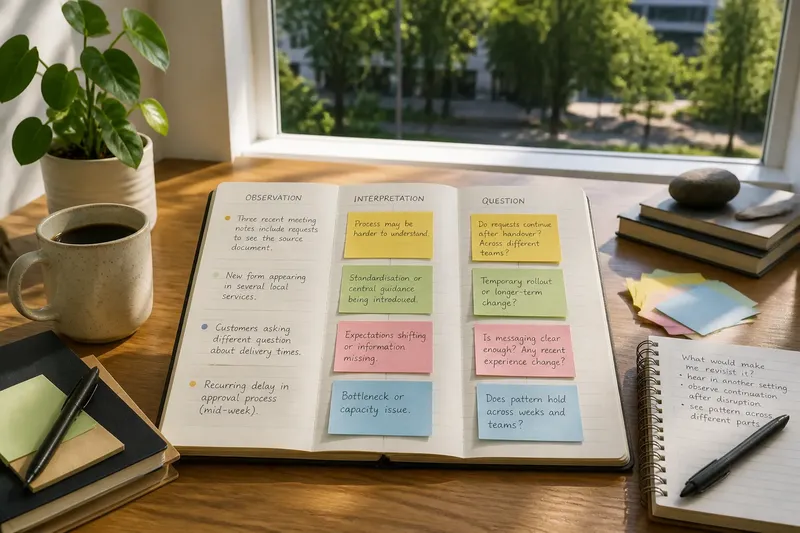
The common mistake in noticing change is to turn the first striking observation into a prediction. A quiet hour for mapping changes you keep noticing offers a better use for that attention: separate what you have observed from what you think it might mean, then keep the questions that deserve another look. The result is not a forecast. It is a small, revisable map of signals.
What belongs on a signal map?
A signal is an observation that may matter because it hints at a change in behaviour, conditions, expectations or constraints. It is not automatically a trend, and it does not need to be dramatic. A new form appearing in several local services, a different question appearing in customer conversations, or a recurring delay in a familiar process may all be worth noting.
“Signal” describes the possible relevance of an observation, not its certainty. One incident may be unusual; several similar observations may still have a shared cause that is temporary. The map helps you hold those possibilities open rather than settling the explanation too soon.
For this exercise, keep three things distinct:
- Observation: what you saw, heard or read, stated as plainly as you can.
- Interpretation: the meaning you currently suspect.
- Question: what remains unclear and would help you judge its relevance.
Writing these separately is a little like sorting a drawer before deciding what to keep. When observations and interpretations are mixed together, a neat story can conceal how little is actually known.
How can one hour keep the exercise calm?
Give the hour a modest aim: make a short list of observations and questions, not a complete account of the future. Choose a notebook, plain paper or a document that is easy to revisit. Silence alerts if you can, and bring a handful of notes, messages or examples that prompted your attention. Avoid searching for more material simply to make the session feel productive.
Begin by writing the observations without explaining them. Keep each entry concrete enough that another person could understand what you noticed. “People are losing trust” is already an interpretation. “Three recent meeting notes include requests to see the source document” is an observation, provided those notes are actually available to you.
Next, add a tentative interpretation and an open question beside each entry. Do not polish the wording into a compelling narrative. If you cannot state the observation without relying on an assumption, mark that gap rather than disguising it.
In the final part of the hour, group observations that seem related, choose which ones merit attention and note what would make you reconsider them. Leave room for an entry to remain unresolved. A useful map can be brief because its purpose is to direct attention, not to represent everything that might change.
Which questions separate an observation from a prediction?
What did I actually notice?
Describe the event, wording, practice or condition without adding a cause. Include enough context to remember where the observation came from, but do not treat a source’s claim as confirmed merely because it is written down.
What makes this observation recur?
Look for repetition in place, timing, people or circumstances, and ask whether the instances are genuinely comparable. Recurrence can make an observation worth watching; it does not establish that the same pattern will continue.
What else could explain it?
List a plausible alternative, such as a temporary policy, a one-off disruption or a change in how information is being recorded. Alternatives are not reasons to dismiss the signal; they show what you would need to distinguish.
What would I need to learn next?
Ask what evidence or conversation could clarify the uncertainty, and whether it is sensible to seek it. Sometimes the most honest next move is simply to keep the question visible rather than pretend to answer it now.
How should you decide what to keep?
A signal deserves a place on the short list when it is understandable, potentially relevant to a decision or concern, and still uncertain enough to warrant a question. It need not satisfy every appealing feature. A striking item with no clear connection to anything you care about can remain in your notes without becoming a priority.
Use a few practical checks rather than a scoring system:
- Can I point to the observation? Keep the wording specific; if it cannot be traced to something seen or heard, label it as an idea instead.
- Is it recurring or newly consequential? Note the basis for either judgement rather than implying broad change from a single incident.
- What decision or concern might it touch? Name the connection, even if it is tentative.
- What explanation would weaken my current interpretation? Record a credible alternative.
- What would make me revisit it? Set a plain condition, such as hearing the same concern in a different setting or seeing the practice continue after a temporary disruption ends.
Then choose a small set for continued attention. The remaining observations are not failures; they can stay in an archive or be dropped. Keeping fewer items makes it easier to notice when an assumption has changed, instead of carrying a crowded list whose entries all seem equally urgent.
What can a worked example look like?
Say you have noticed that colleagues in separate meetings keep asking for written explanations of an internal process. Record that observable behaviour first. Your tentative interpretation might be that the process is becoming harder to understand, while an alternative is that a recent handover has prompted people to request documentation temporarily.
The unanswered question could be whether the requests continue after the handover is complete, and whether they come from people using different parts of the process. If you later hear similar requests in another setting, you have another observation to consider. You still do not have proof of a lasting shift, but you have a clearer basis for asking what may be changing.
This example shows why a signal map should preserve the distance between what happened and what it might mean. If the first request had been written down as “the process is failing”, the interpretation would have swallowed the evidence and made alternative explanations harder to see.
How can you revisit the map without turning it into a forecast?
Return to the list when a relevant observation appears, or when a decision makes the questions newly useful. For each entry, ask whether the original observation still holds, whether a competing explanation has become more plausible, and whether the question remains worth carrying. You can revise, set aside or remove an item without treating the earlier note as a mistake.
Keep the language conditional. “This may indicate a growing need for clearer documentation” leaves room for what you do not know. “Everyone will soon need a new system” turns a limited observation into a sweeping claim. Clear wording matters because future readers may otherwise mistake a note of curiosity for a decision based on certainty.
Also keep the source and context close to the note where possible. A phrase detached from its setting can change meaning as it is repeated. A short reminder of where you encountered it helps you assess whether two apparent examples really belong together.
When should an unanswered question stay unanswered?
Some questions cannot be settled in a quiet hour, and some do not need an immediate answer. If the next piece of information is unavailable, costly to obtain or unlikely to affect a current choice, leave the question open. That is a deliberate boundary, not an incomplete exercise.
Signals can guide attention, but they do not dictate action. If an observation raises a practical concern, consider it alongside the relevant context and the people affected. For broader futures literacy, the value of a quiet hour for mapping changes you keep noticing lies in a more modest skill: seeing what you know, naming what you suspect and keeping uncertainty visible while you decide what deserves attention next.